PolyField & Track Display
A results viewing and display software package for FinishLynx and TimeTronics photo-finish systems. Runs on Windows and Mac as a desktop device linked to your photo-finish results folder.
- PolyField & Track Display
- Overview
- How it works
- Getting started
- The desktop control panel
- Overlays
- Text size & rotation modes
- Browse & restore
- Connecting screens
- The Layout Builder
- Moments
- Results on screen
- Widget reference
- Combined Events points
- Horizontal jump displays
- Throws display
- Vertical jump displays
- Themes, bibs & club abbreviations
- Web views
- FinishLynx & TimeTronics setup
- Webcasting with OBS
- Networking
- Troubleshooting
- Download & support
- API integration
Overview
PolyField & Track Display turns your FinishLynx or TimeTronics results into live displays across your venue. One desktop instance watches your results folder and serves a web interface that any device on the network can open — scoreboards, an athlete self-service kiosk, a speed board, and more.
It keeps the operator in control: results only appear once they are saved, ensuring positive validation before display. Multiple saves are supported — so you can show distance-race athletes early, or reveal a race once the top 3 have performances assigned.
How it works
- You run one instance of the desktop app on a computer connected to your photo-finish results folder.
- The app builds a web interface on port 3000. Any device on the same network opens it in a browser — no install needed on the displays.
- Each display registers itself and can be given a layout to show. The number of displays is limited only by your network and the host computer.
- The operator drives what appears — results, overlays (text, screensaver, countdown, records, line view), or a full custom layout.
Getting started
1. Set the results directory
This is the folder FinishLynx or TimeTronics saves results into (LIF, etc.). Click the red button in the top-right corner, “Select Results Folder”. You can change it later with “Change Folder”.
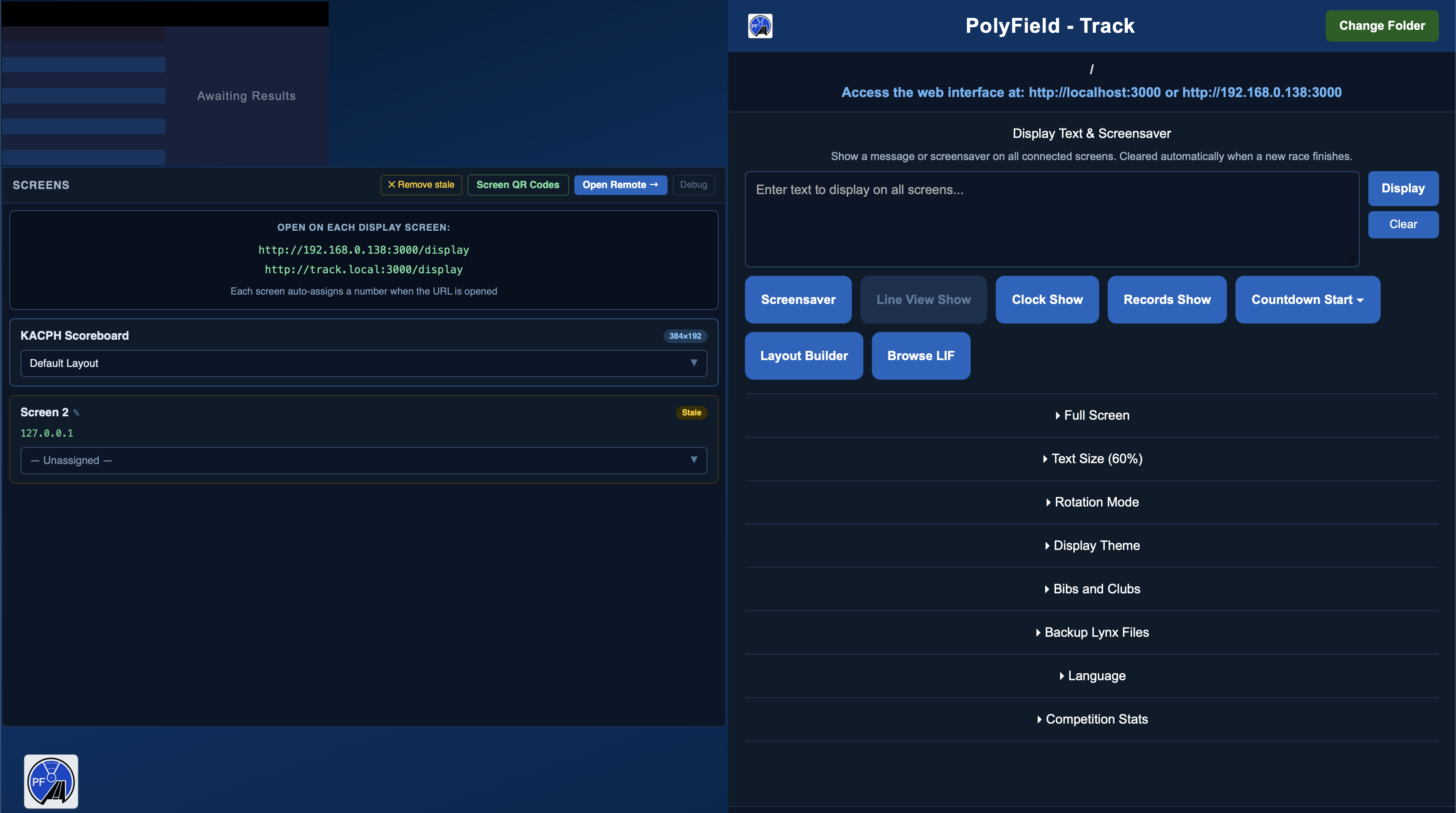
Once set, the web interface builds and the access address is shown at the top of the desktop app (e.g. http://display.local:3000 or http://<your-IP>:3000).
2. Open a display
On each display device, open a browser and go to the address shown, then /display. Each screen that connects auto-assigns a number. See Connecting screens for the QR-code shortcut.
Tip — leave the desktop app on its home screen and drive the displays from there, or from a second device on the web interface. This keeps you in control of the overlays while the results flow automatically.
The desktop control panel
The control panel is the operator’s home. Along the top you set the results folder and see the connection address. The main controls are grouped into a compact button row (which wraps to a second row on narrow windows):
| Control | What it does |
|---|---|
| Text & screensaver | Type a message to show on all screens, or link a graphic. Great for sponsor messages, “meet suspended”, etc. |
| Screensaver | Show a linked image or a chosen saved layout across the screensaver area. If a source is already set, one press toggles it on/off; the ⚙ button re-opens the options. |
| Line View | Push the latest photo-finish image to the displays. Greyed out until photo-finish JPGs appear in the results folder. |
| Clock | Show the running clock full-screen on screens with a clock widget. |
| Test moment / Podium / Manual Selection | Shown once a layout uses Moments: play a sample card on every screen, show the current result’s podium, or send a record you choose. See Moments. |
| Countdown | Count down to a target time of day. Enter the time and Start; it hides itself at zero. |
| Layout Builder | Open the layout designer (see below). |
| Browse LIF | Re-show any previous result from the monitored folder. Its first option, Blank, clears the result from every screen. |
Overlays
Overlays are things you show on top of (or instead of) the results: text, screensaver, line view, clock, records and countdown. Three important points about how they work:
- You can run several at once. For example a screensaver background with a countdown and a text banner on top. Turning one on no longer turns the others off.
- The widgets decide what shows where. Each display only shows the overlays that its assigned layout contains — so different screens can show different combinations from one desktop.
- A new result clears them all and returns every screen to the results — so live results always take priority.
Screensaver (image or layout)
Choose Image (a linked graphic — sponsor boards, notices) or Layout (any saved layout shown as a full takeover of the screensaver area). Pick the source, then press Display. Once a source is set, the Screensaver button toggles it directly.
Countdown
Counts down to a target time of day, read from each screen’s own clock. Enter the time (e.g. 15:40) and Start. In the Layout Builder you can set the caption (default “Next Event In:”), whether seconds are shown, and the text/font/colour. It hides itself at zero and yields to new results and other overlays.
Records
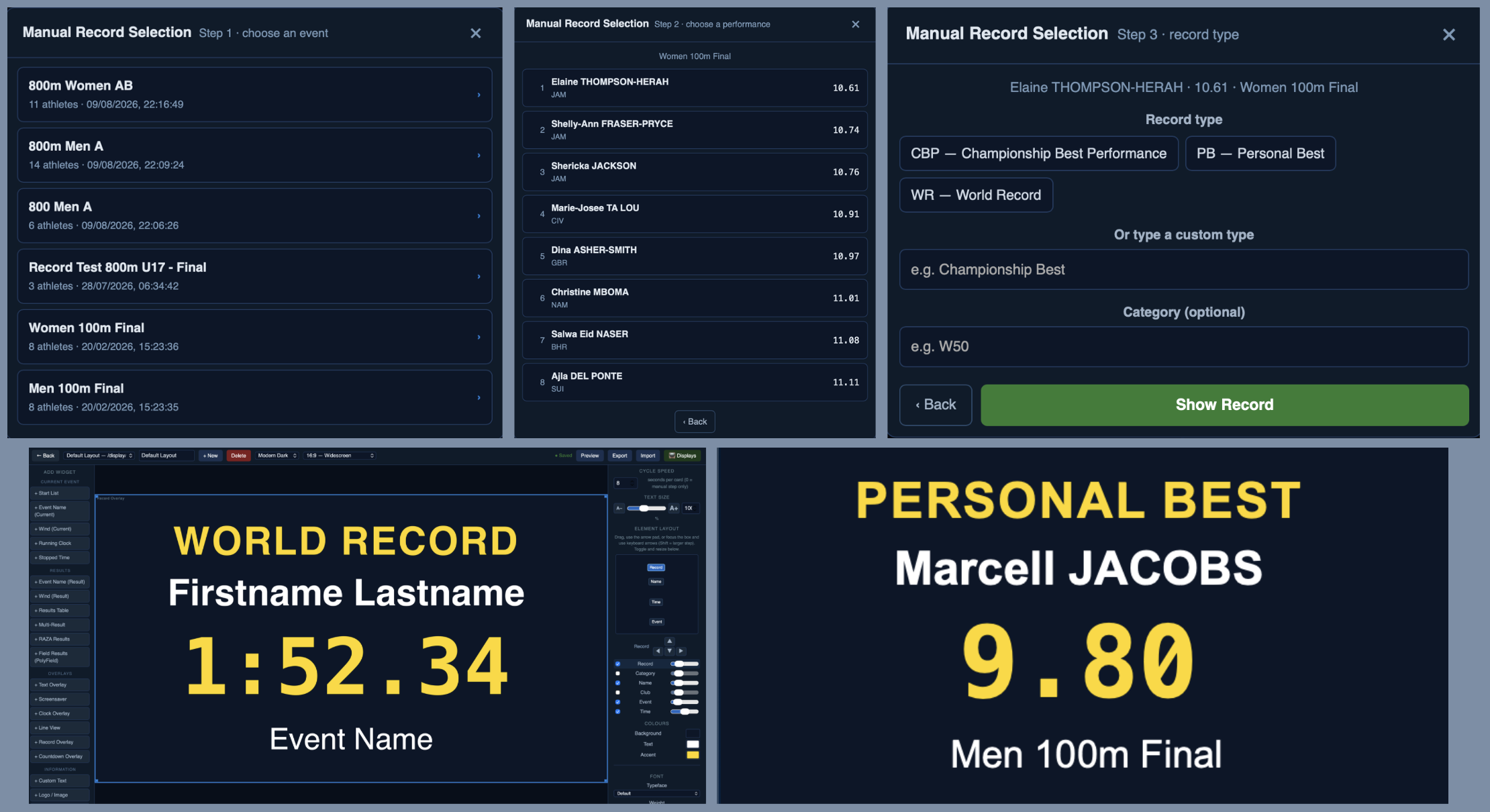
Records now play as Moments. Flag an athlete’s record in FinishLynx User 3 (e.g. PB or W50 WR) and every screen using Moments shows a record card when the result is saved. For a record FinishLynx didn’t flag, press Manual Selection in the main window: 1. choose the race, 2. choose the performance, 3. choose or enter the record type.
Line view
Sends the latest photo-finish image to displays with a line-view widget. The Rotation (s) control sets how often it alternates the photo with the result.
Text size & rotation modes
The default results text size is adjusted with the + and − buttons (layout widgets have their own Text Size in the Layout Builder).
The rotation mode determines how results with more than 8 competitors display:
| Mode | Behaviour |
|---|---|
| Scroll | Top 3 rows locked; rows 4+ scroll through the remaining competitors. |
| Page | Paginates: 1–8, then 9–16, etc. on rotation. |
| Scroll All | All 8 rows scroll through the competitors with no locked positions. |
The default athlete rotation speed is 5 seconds.
Browse & restore
Browse LIF lists previous results from the monitored folder so you can re-show any of them — useful for photo opportunities or re-displaying an earlier heat. Opening an old file in FinishLynx does not disturb the live display; only a genuine change to a result promotes it.
Blank, at the top of the list, clears the result from every screen back to Awaiting Results. The next saved result shows as normal.
Connecting screens
Open http://<address>:3000/display on each screen; it auto-assigns a number. The Screen QR Codes page (from the Screens panel, or /screens-overview) shows a scannable code for every display page, so you can point a phone, tablet or TV browser at the right page quickly.
In the Screens panel you assign a saved layout to each screen independently, and remove screens that are no longer live. The desktop also has a built-in scoreboard preview that mirrors a real screen when you assign it a layout.
Screens reload themselves after the app restarts and keep their number and layout. To check a layout on the real screens, use Preview → On displays in the Layout Builder.
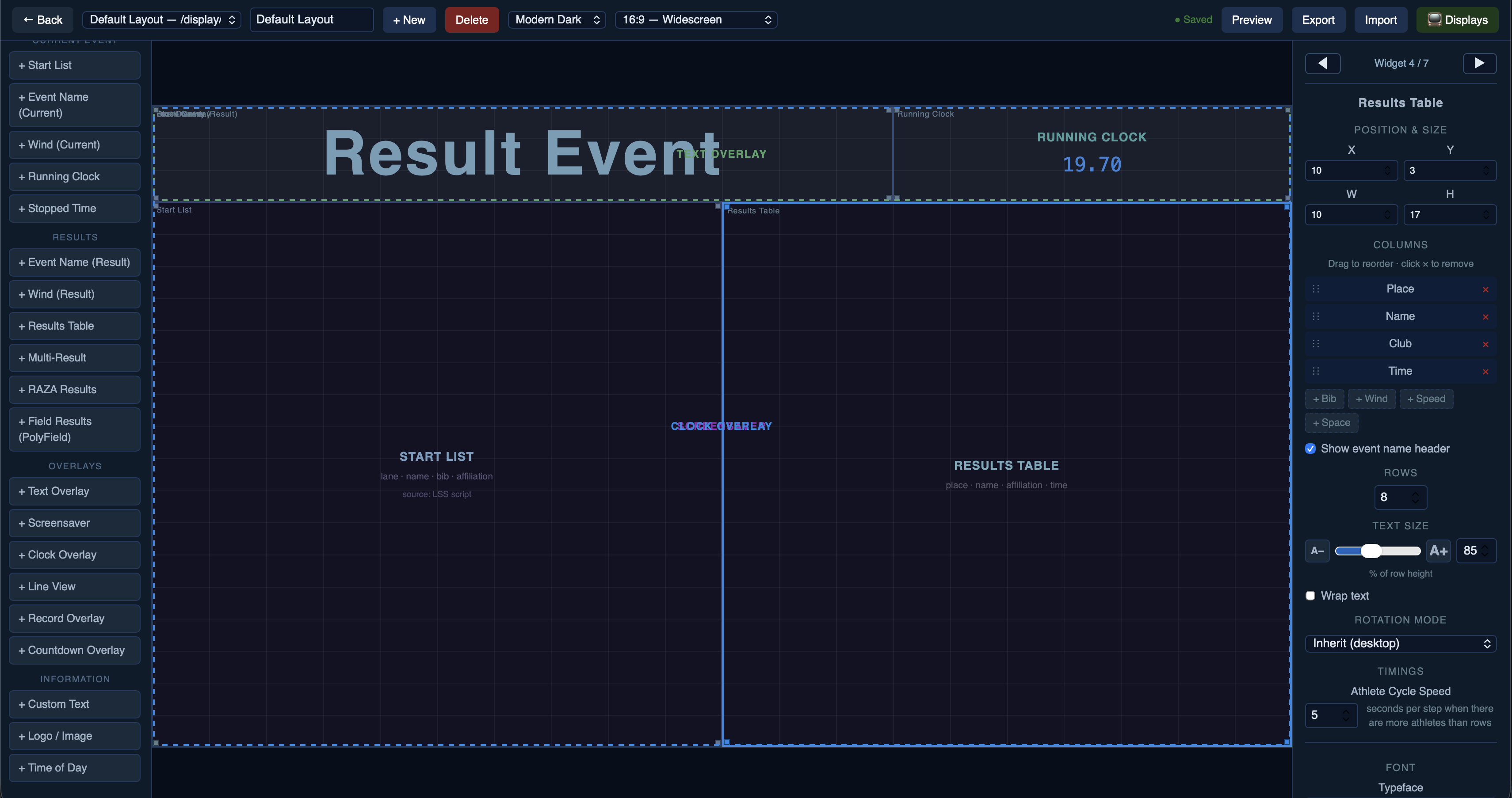
The Layout Builder
Open the Layout Builder to design layouts from widgets. Each layout has a canvas shape and a theme.
- Start from a template, or drag widgets from the list on the left onto the canvas.
- Select a widget to edit it in the Widget panel on the right. The essentials come first; the rest is under More settings. The Canvas panel holds the layout’s own settings: name, theme, shape, Show on screens and Moments.
- Text inside a widget can be dragged on the canvas once the widget is selected. Pieces snap into line and can be left, centre or right aligned.
- Undo with ⌘/Ctrl+Z, and press ? for every shortcut. The side panels fold away to give the canvas more room.
- Show on screens — tick the screens a layout should appear on.
- Preview — In browser shows the layout here with sample or live data. On displays shows it on every connected screen until you stop; each screen then returns to its own layout.
Moments
Moments are short cards that play on the screens when a result is saved. Switch them on per layout: Canvas → Moments → Use moments on this layout.
- After a race, show — the Winner (with the winning margin) or the Podium. For para races the podium is ranked by RAZA score.
- Photo finish for close races — plays first when the top two are within 0.05 s (adjustable), with the finish image if FinishLynx saved one for that race.
- Records from the result — every athlete flagged in FinishLynx User 3 gets a card. A winner’s record goes on the winner’s own card.
- Finals only — on by default, so cards only play for events with “Final” in the name. Records play in any round.
- Play over — the whole screen, or just one widget.
A card plays once per race, as soon as the result is saved — never when a page reloads or when you re-show an old result. In the main window, Test moment plays a sample card on every screen using Moments, and Podium shows the current result’s top three, for medal ceremonies.
Wipe between results
When a different event’s result comes up, a 2-second wipe with the PolyField logo plays first, and the results then cascade in. It’s on for every layout. Choose The wipe shows to use one of your own layouts instead (a sponsor board, for example), or untick Wipe between different results.
Results on screen
- Cascade — a new result comes in row by row, winner first. A corrected result glides rows into their new places. Untick Animate rows when results arrive or change on the widget to turn it off.
- Text that fits — long names and event names shrink to fit instead of being cut off.
- Para races — when the event file gives athletes a WPA class, the results table adds Class and RAZA columns, keeping finishing order.
- No names — some races only have bib numbers; rows and cards then show the bib.
- Themes — results, field boards and clocks follow the layout’s theme.
Widget reference
| Widget | Shows |
|---|---|
| Results Table | The current result, with configurable columns, rotation and text size. |
| Multi-Result | A grid of several results (2×2 / 3×2), latest or rotating. |
| Start List | The start list for the current event. |
| Running Clock / Stopped Time | Live or frozen clock. |
| Event Name / Wind | Current or result event name and wind. |
| Custom Text / Logo / Time of Day | Static text, an image/logo, or the time. |
| Field Results / Recent Results / Throws / Jump Ruler / Vertical Jumps | Live field-event displays fed by PolyField Server, grouped under PolyField Server. See Throws, Horizontal jump displays and Vertical jump displays. |
| Text / Screensaver / Line View / Clock overlays | The text banner, screensaver image/layout, photo finish, and full-screen clock (shown when the operator triggers the matching overlay). |
| Countdown Overlay | Countdown to a target time with an editable caption. |
Combined Events points
For a combined-events (multi-event) competition, the results table can show an extra Combined Event column that scores each track performance against the official 2026 UKA/ESAA Combined Events Score Tables.
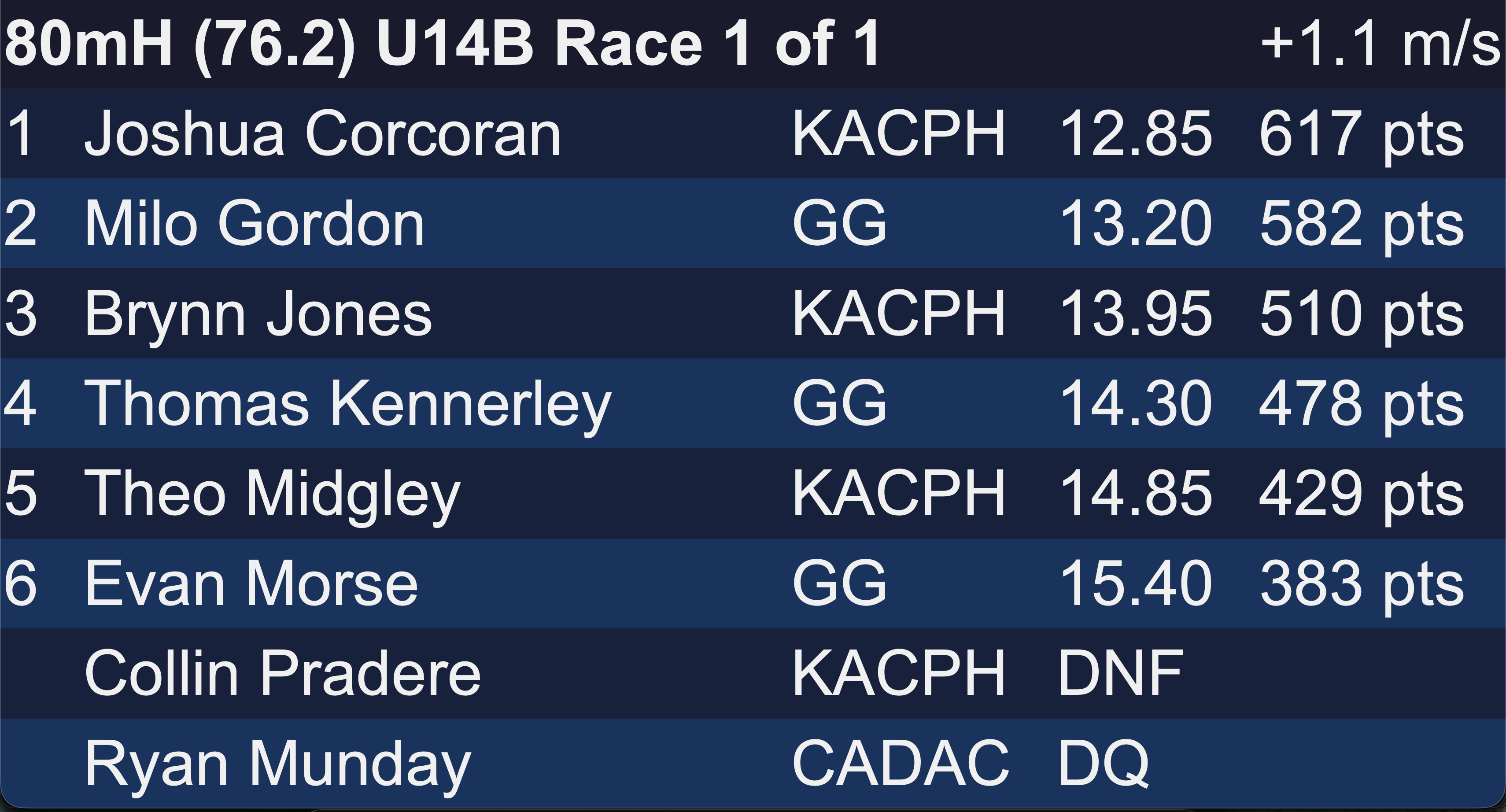
- Add the column — in the Layout Builder, select a Results Table or Multi-Result widget and add the Combined Event column (Properties → Columns). Tick Append “pts” to Combined Events points column to show
617 ptsrather than617. - Automatic by event & gender — the scoring table is chosen from the event name (e.g.
80mH (76.2) U14B), so every age group is covered — U13 to U20, Senior and Masters — with no per-athlete setup. - Track only — hurdles and flat races are scored; field events, relays and any event without a matching table are left blank.
- Non-finishers — DNS athletes are not shown; DNF and DQ show no score.
The time used for the lookup is the value displayed (already rounded to the timing precision), so the points match the official tables exactly.
Horizontal jump displays
These widgets show live field-event data from PolyField Server on the same network. Add them from the PolyField Server group in the Layout Builder. Set the server’s address once in the main window, under PolyField Server; every field widget uses it.
Jump Ruler (PolyField)
A pit-side ruler for long jump and triple jump — ideal for a long, thin LED strip beside the runway (e.g. 500 mm × 4–6 m). It draws a distance scale with metre / 50 cm / 10 cm ticks, marks the leading three jumps, and shows the current jumper’s details.
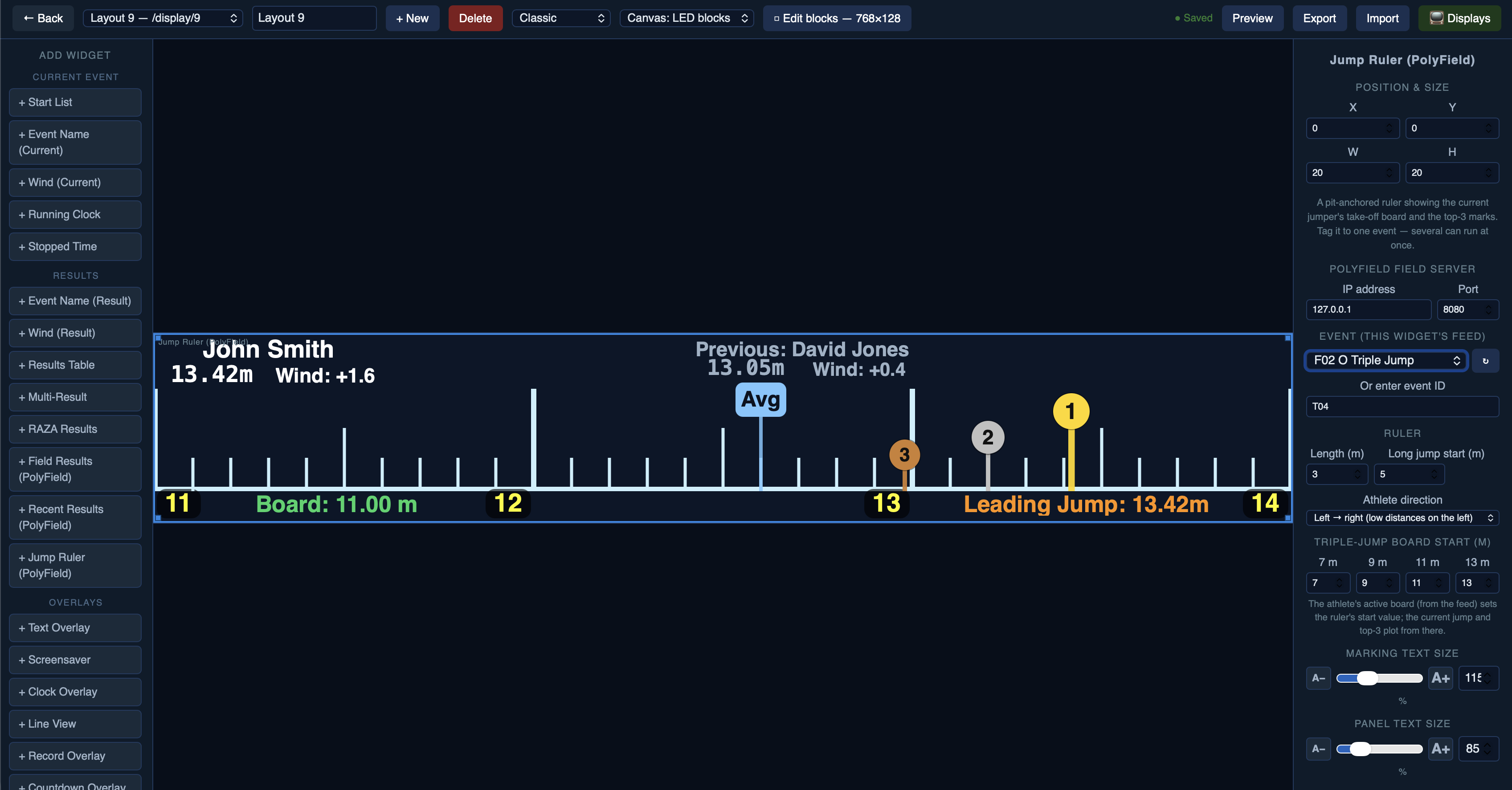
- Follows the event in progress. By default the ruler shows whichever horizontal-jumps event is in progress and moves on by itself. For rulers in different areas, tick the events each one should show. New rulers keep their text in a band above the pins.
- Take-off board. The scale is pit-anchored: enter the ruler start for long jump and for each triple-jump board (7 / 9 / 11 / 13 m, to 2 decimal places, e.g.
11.02). The athlete’s active board (from the feed) sets which start the ruler uses, so marks always land in the right place. - Top-3 pins. The leading three marks show as height-staggered pins (1st tallest, then 2nd and 3rd), with 1st always drawn in front. A mark outside the visible range shows as an arrowhead at the edge pointing its way.
- Average pin. An optional Avg pin plots the competition average.
- Athlete panel. Drag-position each piece — current athlete, current mark & wind, previous athlete with their mark & wind, current board and best of competition — and set each one’s caption, colour, size and visibility. Lay them out as a top banner or a side panel.
- Athlete direction. Choose left → right or right → left so the scale matches the way athletes run into the pit.
- The flow: an athlete is selected → shown as current (no mark yet); their jump is measured → current mark & wind appear; the next athlete is selected → they become current and the last jumper moves to previous.
Field Results & Recent Results (PolyField)
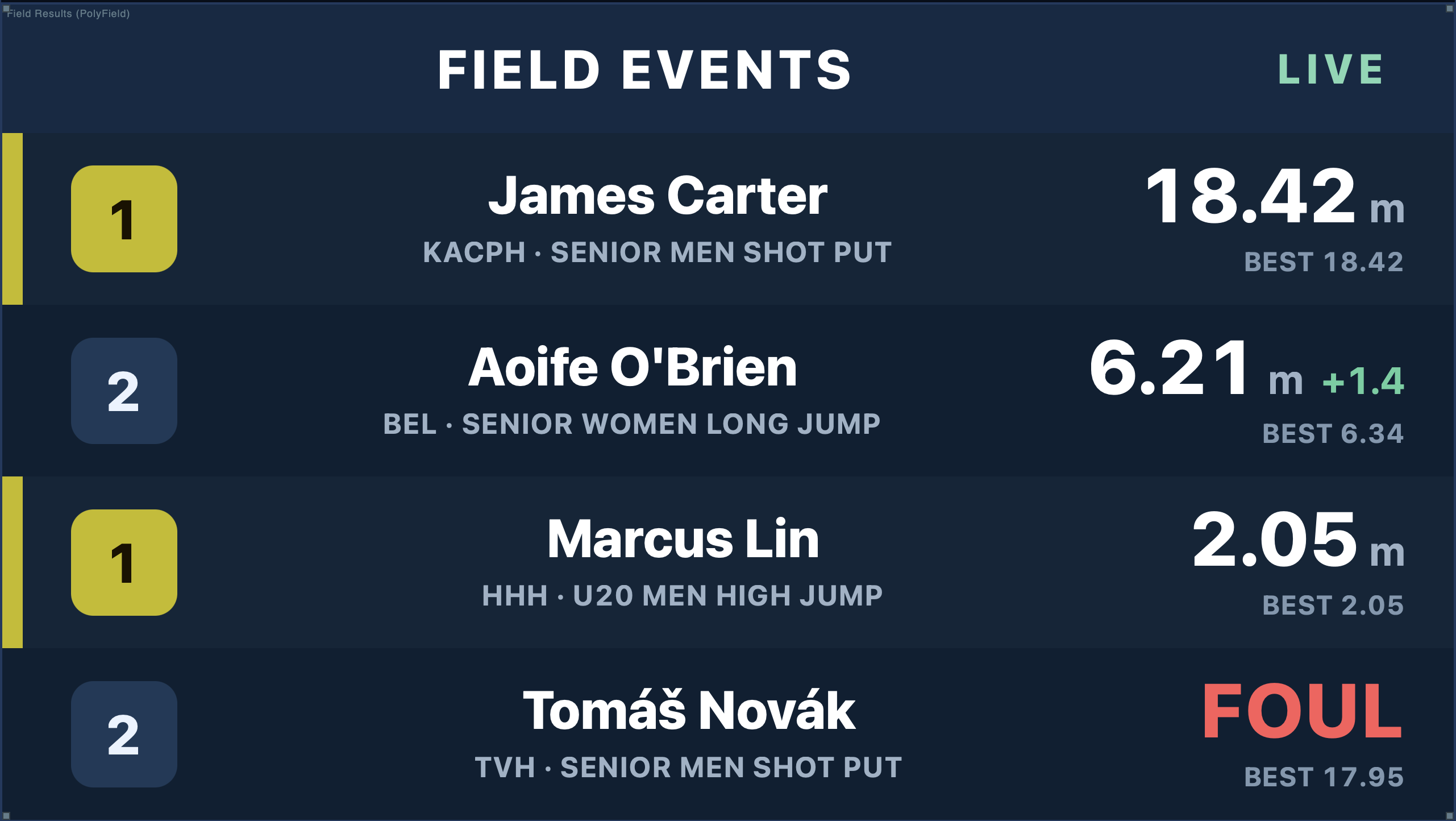
Field Results (PolyField) — a live standings board for field events (rank, athlete, club, event, mark, best), with the leader highlighted and fouls shown in red.
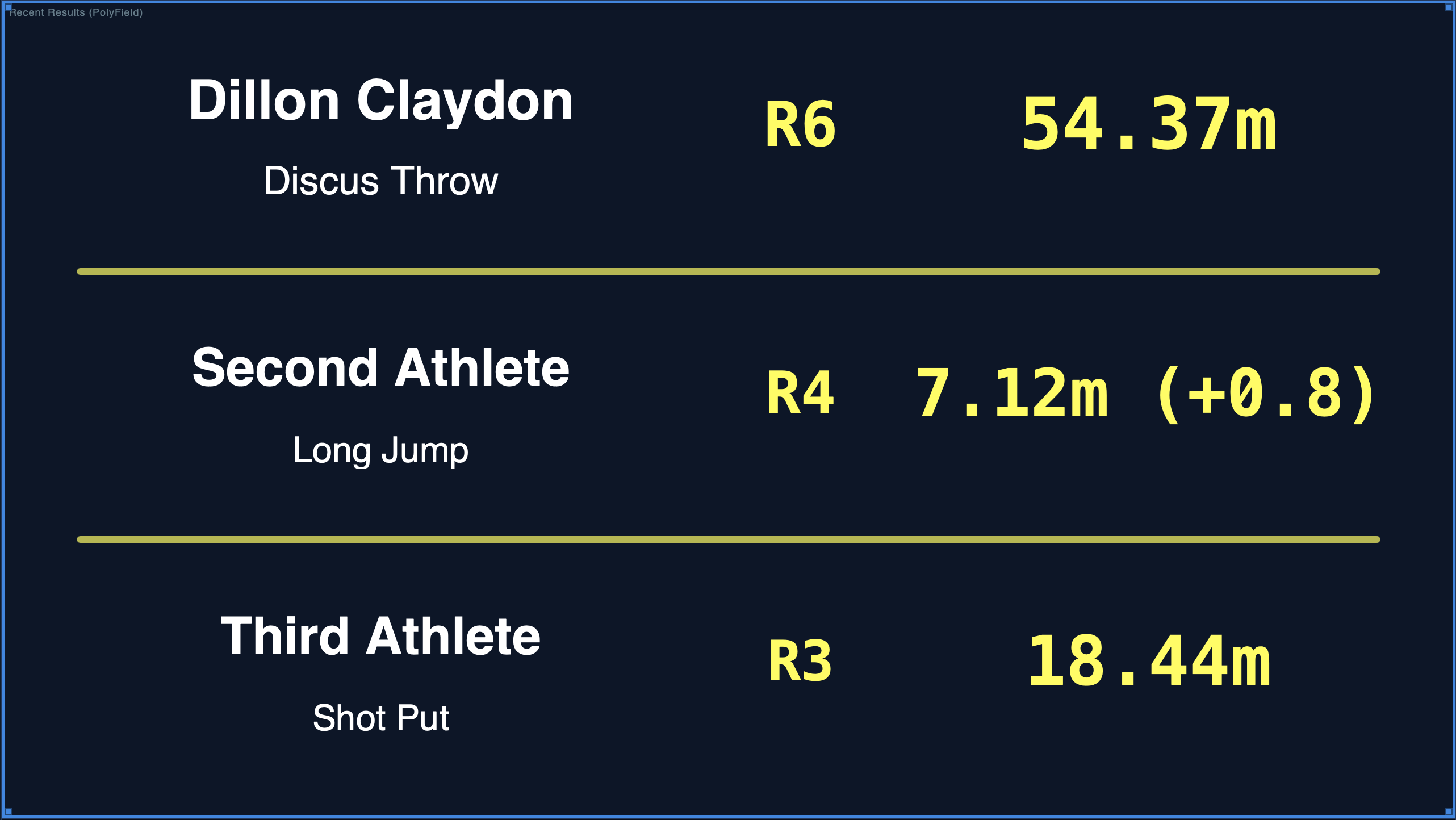
Recent Results (PolyField) — the last three completed field performances (name, event, round and mark, with wind for horizontal jumps).
Throws display
Throws shows a shot, discus, hammer or javelin competition from PolyField Server, with every landing plotted in the sector and distance arcs. Like the other field boards it follows the event in progress by default.
- The current athlete’s throws, numbered by round; everyone else’s landings as a heat map; the competition best as a gold star.
- The latest throw drops in as it’s measured. If it takes the lead, a NEW BEST banner wipes across first.
- Athlete, club, round, performance, position, best and needed to lead are separate text pieces you drag into place.
- Small LED panel makes markers bigger and removes fine detail for low-resolution walls. The sector sits in a box you size, so it never runs into the text.
- Needs the PolyField Server version that sends rotated landing coordinates.
Vertical jump displays
Vertical Jumps shows a high jump or pole vault competition. Like the other field boards it follows the event in progress by default; tick events to tie a board to its area. It’s in the PolyField Server palette group and has two styles.
Advanced — qualifying board
A horizontal bar, labelled with the current height, divides the display like a qualifying board.
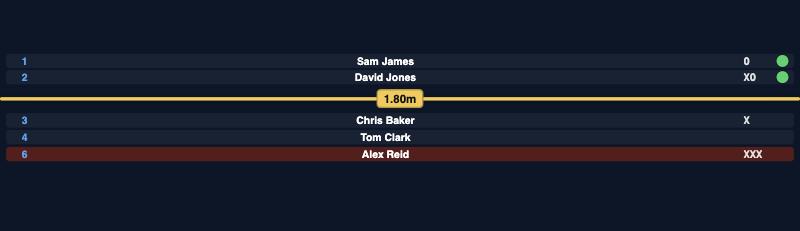
- Athletes still to clear sit below the bar. When one clears they rise above it with a green dot; a failed attempt shows a red dot and they stay below; an athlete out of the competition has a red row.
- When the height changes the bar reveals with an animation, every athlete resets below it, and the eliminated drop off. Athletes who pass the height don’t appear.
- The bar’s vertical position tracks the ratio of cleared to not-yet-cleared, and if more athletes are in than rows, the list rotates so everyone is shown.
- The data lines up in columns (place · name · attempts · marker) so it stays tidy whatever the name lengths.
Simplified — current-state card
A single card showing the athlete up now: the current height, their name, their attempts at that height and their full series.
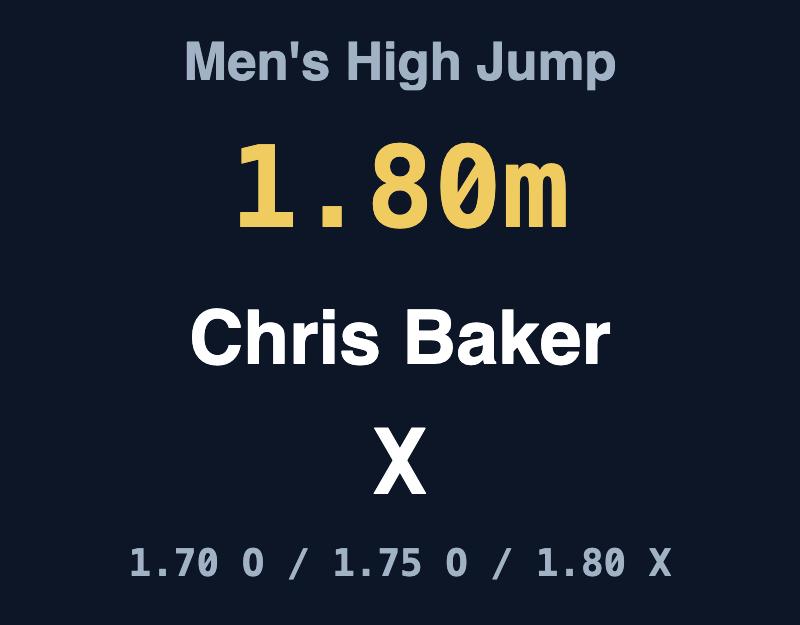
Each piece — event name, height, athlete, attempts, series, and optional place / best / bib — is drag-positioned with its own caption, colour, size and visibility, like the Jump Ruler’s panel.
Shared options
- No height set. Before a bar height is announced (it would read
0.00 m), the widget shows the event name and a sponsor logo instead. - Sponsor logo. Optional — shown on that idle card, and (advanced) under the bar during the height change.
- Configurable — rows, text size and font, the colours (bar, cleared, failed, out, accent) and the bar-reveal duration.
Themes, bibs & club abbreviations
Themes set the default colours for all displays; you can create, duplicate and edit them. Bibs can be shown or hidden in the results view. Club abbreviations are managed centrally (edit the club list) and applied everywhere — add a new club or override a built-in abbreviation, and changes reach all displays within a few seconds.
Web views
The web views are best accessed through the web interface, using the access details at the top of the desktop app. Key pages:
| Page | URL |
|---|---|
| Scoreboard (activated layout) | /scoreboard |
| Display screen | /display |
| Multi-Result view | /results |
| Athlete kiosk | /athlete |
| Speed board | /speed |
| Running clock | /clock |
| RAZA rankings | /raza |
| Screen QR codes | /screens-overview |
Multi-Result view
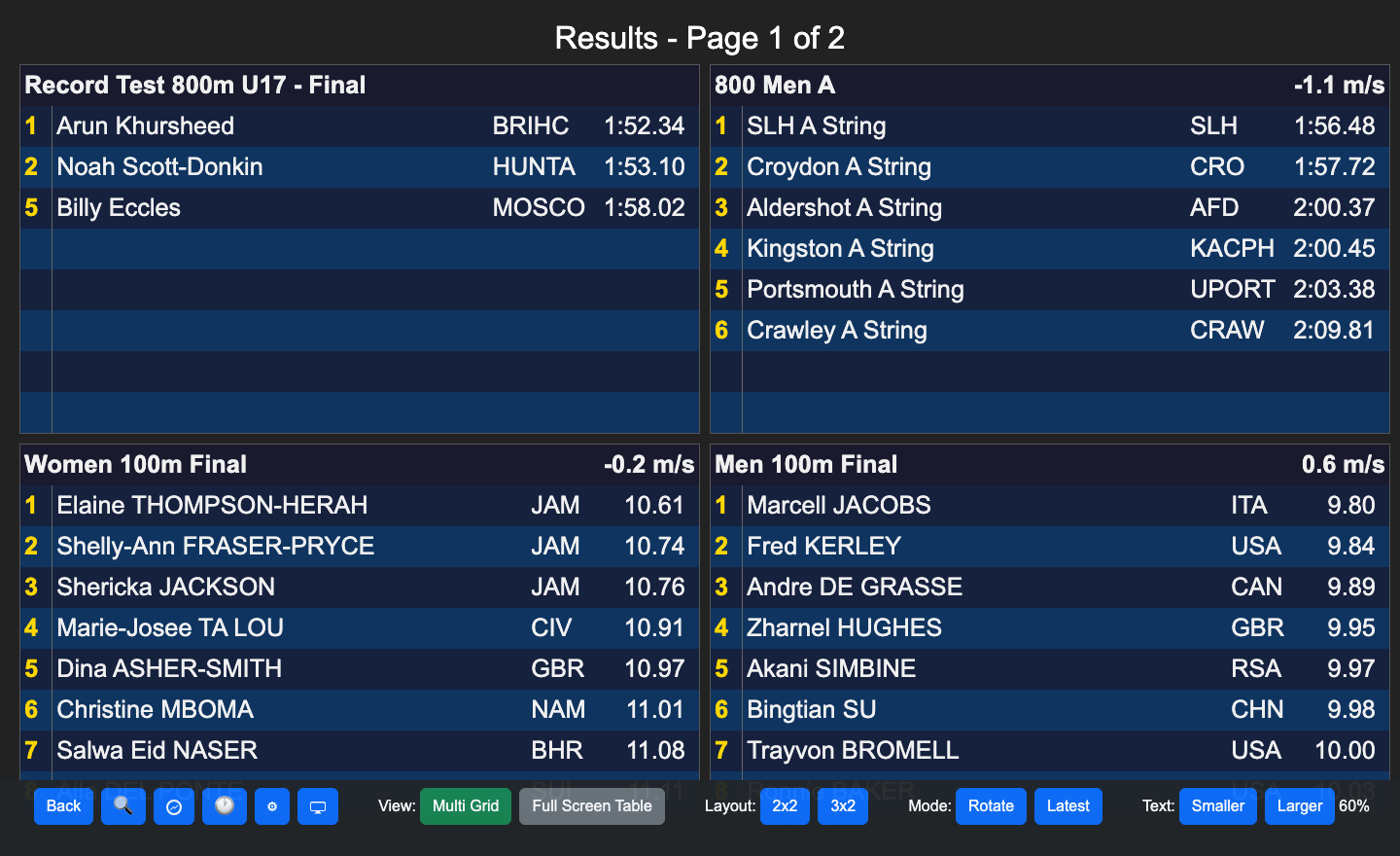
Displays results in a 2×2 or 3×2 matrix. Configure it to show the latest results or rotate through all available results; adapt the text size; and use full-screen mode to hide the toolbar (any mouse movement pops it back up). Results paginate, with the current page shown at the top. The search icon opens the athlete kiosk.
Athlete kiosk (self-service)
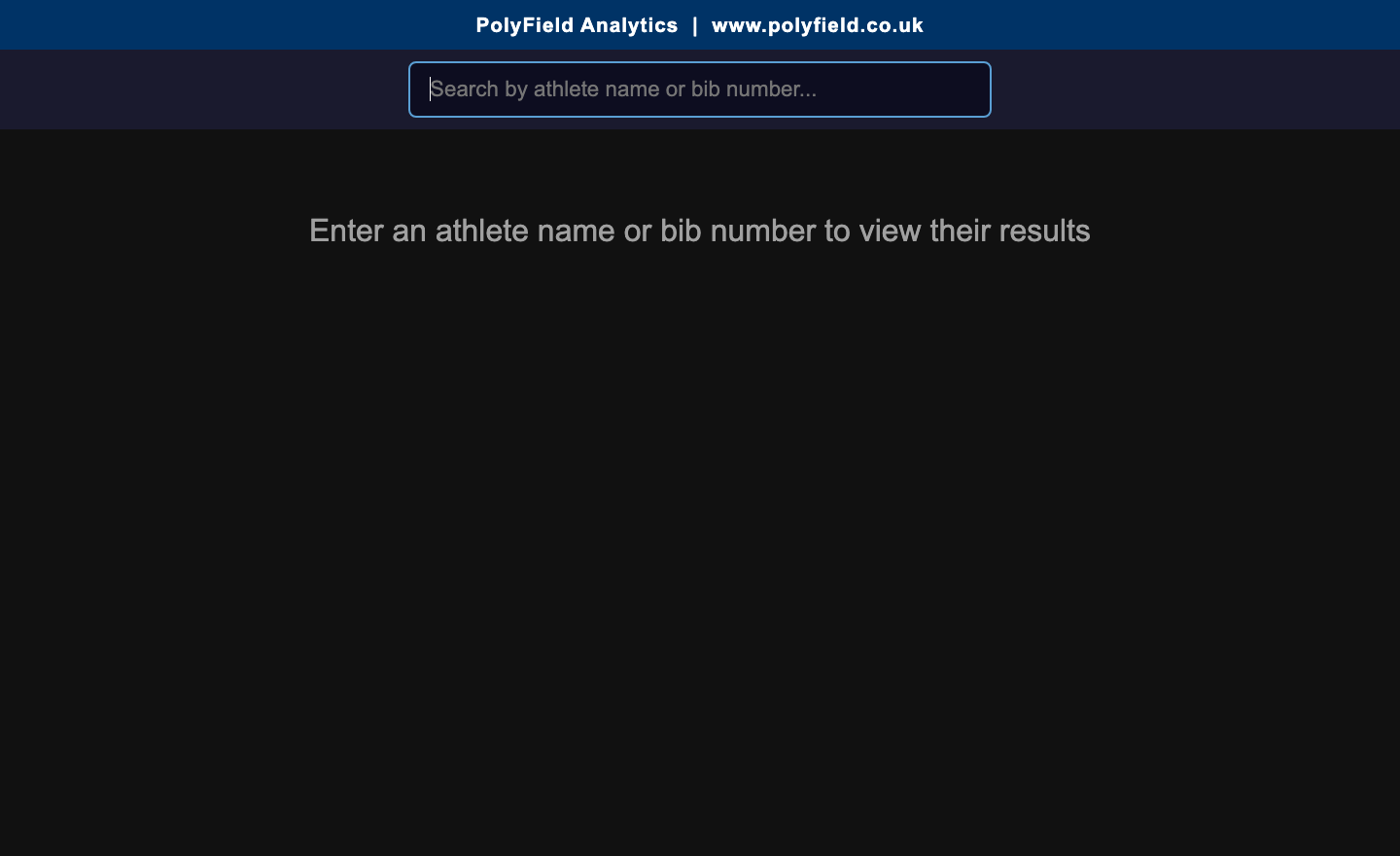
Open <IP-ADDRESS>:3000/athlete. An athlete searches by name or bib number; clicking a name shows all their performances in the current results directory. Clicking a result card displays it full-screen for photo opportunities. Reset clears the search; the back button returns to the search field.
FinishLynx & TimeTronics setup
- Scoreboard scripts — use the supplied
polyfield.lss,polyfield-wind.lssandpolyfield-backup.lssscripts so FinishLynx sends the live running clock, wind, start lists and results to PolyField & Track Display. See Scoreboard setup below for how to configure each output. - Records — flag an athlete’s record in the FinishLynx User 3 field (e.g.
PBorW50 WR). Record codes are expanded to full titles from the club list. - Line view — export your photo-finish images (JPG) into the monitored results folder; the Line View button enables once they appear.
- Results — save your LIF as normal; PolyField only displays saved results.
Scoreboard setup (FinishLynx)
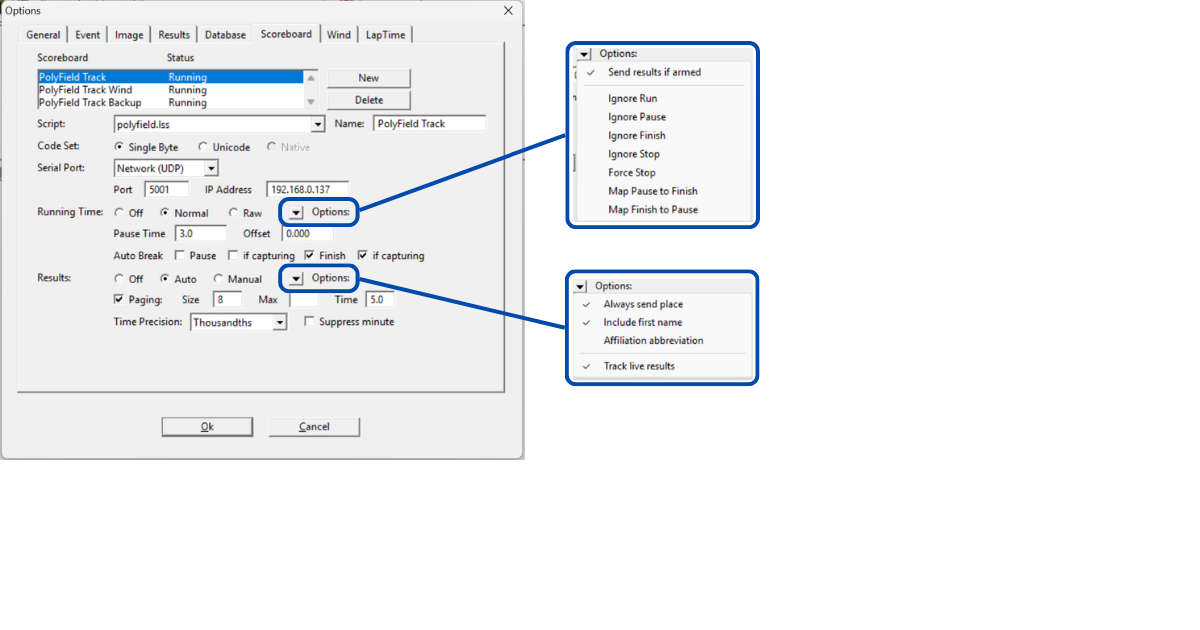
PolyField & Track Display receives the running clock, start lists, live results and wind over a single UDP feed on port 5001. FinishLynx sends this through its Scoreboard outputs (Options → Scoreboard). Set up the outputs below — each is a Network (UDP) scoreboard pointed at the computer running PolyField & Track Display.
Settings common to every output:
| Setting | Value |
|---|---|
| Serial Port | Network (UDP) |
| Port | 5001 |
| IP Address | the IP of the computer running PolyField & Track Display |
| Code Set | Single Byte |
| Results | Auto · Paging on |
1. Main output — polyfield.lss
The primary feed: running clock, start lists and live results.
- Script:
polyfield.lss· Name: PolyField & Track Display - Running Time: Normal
- Running Time → Options: Send results if armed ✓
- Auto Break: Finish ✓ (with if capturing ✓)
- Results → Options: Always send place ✓ · Include first name ✓ · Track live results ✓ (leave Affiliation abbreviation off — PolyField & Track Display expands club names from its own club list)
2. Wind output — polyfield-wind.lss
A dedicated output for wind readings.
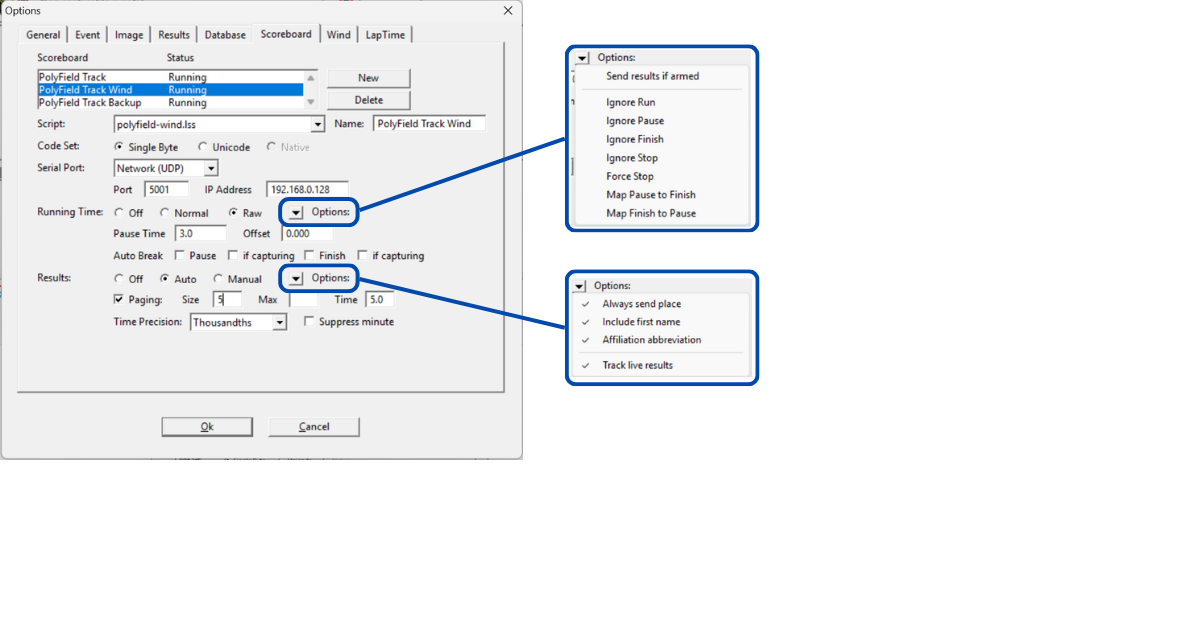
- Script:
polyfield-wind.lss· Name: PolyField & Track Display Wind - Running Time: Raw — wind fires on every beam break; Raw mode passes each reading straight through (PolyField & Track Display ignores the “no data” values)
- Running Time → Options: Send results if armed off
- Results → Options: Always send place ✓ · Include first name ✓ · Affiliation abbreviation ✓ · Track live results ✓
3. Backup output — polyfield-backup.lss (recommended)
A second, independent copy of the start list for resilience. FinishLynx sends each start list only once when the event loads, so a single dropped UDP packet can leave a screen blank. This backup output sends an identical start list from a separate scoreboard, so if one packet is lost the other still arrives. Point it at the same PolyField & Track Display computer.
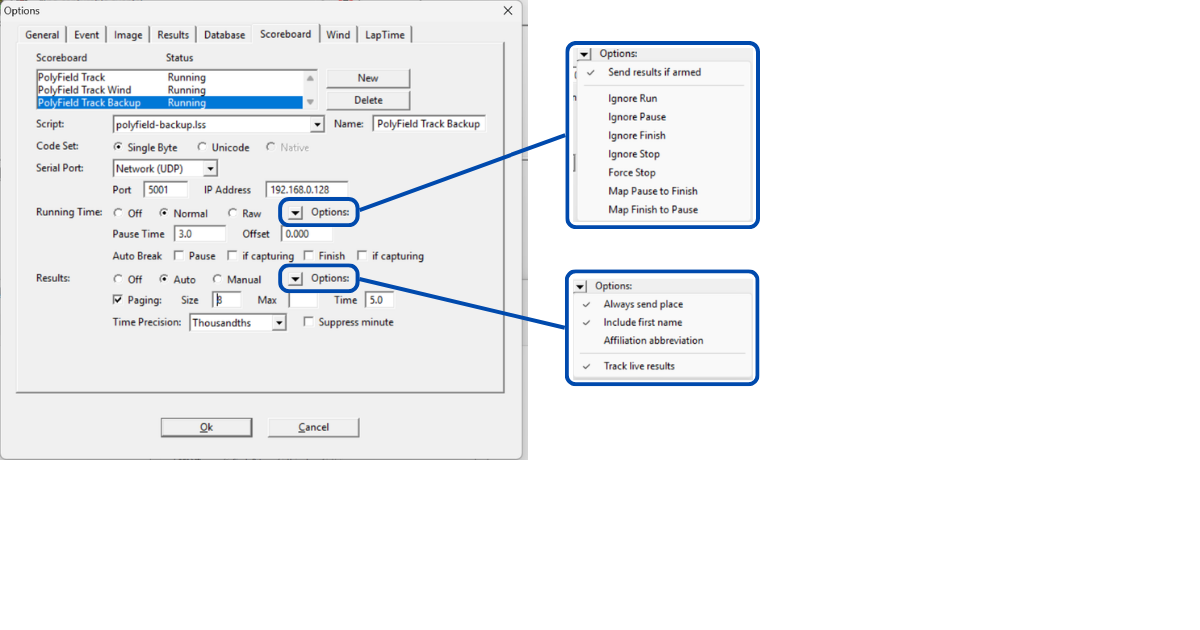
- Script:
polyfield-backup.lss· Name: PolyField & Track Display Backup - Running Time: Normal
- Running Time → Options: Send results if armed ✓
- Results → Options: Always send place ✓ · Include first name ✓ · Track live results ✓
All three outputs can run at once and send to the same IP and port — PolyField & Track Display sorts them out by content.
Webcasting with OBS
Use PolyField & Track Display as a see-through graphics layer over a video stream in OBS.
- Build a layout for the stream — the Webcast lower third template is a good start. Keep widgets to the edges of the picture.
- In OBS add a Browser source, 1920 × 1080, with the address
http://<address>:3000/display/<number>?transparent=1. - In the Layout Builder, tick that screen under Show on screens on your stream layout.
Everything that isn’t a widget is see-through, and widgets with no data yet stay hidden. Untick Wipe between different results on the stream layout so the wipe doesn’t cover the camera.
Streaming without the results network’s data — if your results network runs on a 4G SIM, connect the OBS computer to both networks and give the results network adapter no default gateway. The stream then goes out over the other connection.
Networking
- The app serves on port 3000 and advertises itself as
display.local, so displays can usehttp://display.local:3000without knowing the IP. Screens set up with the oldtrack.localkeep working. - Set the PolyField Server address once in the main window; every field widget uses it.
- On computers with more than one network card (common on Windows), pick the correct network adapter in the connection panel so the right address is advertised.
- All devices must be on the same network as the host computer.
Troubleshooting
| Symptom | Check |
|---|---|
| Line View button is greyed out | No photo-finish JPGs in the monitored folder yet — check your FinishLynx image export path. |
| No moment card appears | The layout needs Moments switched on. With Finals only, the event name must contain “Final”. Each race plays once per screen, so saving the same file again won’t replay it. |
| A display shows “waiting for layout” | Assign a layout to that screen in the Screens panel. |
| An old result reappeared | Opening a file in FinishLynx no longer promotes it; only a real change does. Use Browse LIF to re-show past results intentionally. |
| Displays can’t connect | Confirm the same network, port 3000 reachable, and (multi-card PCs) the right network adapter is selected. |
Download & support
Download the latest version from www.polyfield.co.uk or the releases page. Support: support@polyfield.co.uk.
API integration
PolyField & Track Display serves a small read-only HTTP + JSON API on port 3000, on the same local network as your displays. It’s the same interface the built-in displays use, so anything on the LAN — a custom scoreboard, a stats dashboard, a stream overlay, a venue’s own signage — can read live results, the start list and the running clock straight from the app. Requests are plain GET, responses are JSON, there is no authentication, and CORS is open, so a browser page on the LAN can call it directly.
The API is LAN-only by design — the app does not expose it to the internet. Any WAN- or internet-facing integration (remote scoreboards, cloud services, a second venue) should be discussed with us first so it’s done safely, typically over a VPN or a controlled reverse proxy rather than by opening the port to the world. Contact support@polyfield.co.uk.
Base URL: http://<track-pc-ip>:3000 — find the PC’s LAN address from the Displays panel, or from GET /server-info.
| Method & path | Returns |
|---|---|
GET /server-info |
The PC’s LAN IP. |
GET /latest-lif |
The current result (the one on the displays). {} when none. |
GET /all-lif |
An array of all recent results, newest first. |
GET /startlist |
The current event’s start list. |
GET /clock-data |
The live running clock (updates continuously). |
GET /server-info
{ "lanIP": "192.168.0.137" }
GET /latest-lif and GET /all-lif
/latest-lif returns one result object ({} when nothing is loaded); /all-lif returns an array of the same object, newest first. Fields:
fileName— source file name.eventName— event title as sent by the timing system.wind— wind reading with unit (e.g."0.6 m/s"), or empty.modifiedTime— Unix seconds when the result last changed.competitors[]— one entry per athlete:place,id(bib),firstName,lastName,affiliation(club/nation),time(already rounded/formatted), and optionalrecordFlag(e.g."PB","W50 WR").
{
  "fileName": "race01.lif",
  "eventName": "Men 100m Final",
  "wind": "0.6 m/s",
  "modifiedTime": 1790447000,
  "competitors": [
    { "place": "1", "id": "1001", "firstName": "Marcell", "lastName": "JACOBS",   "affiliation": "ITA", "time": "9.80", "recordFlag": "PB" },
    { "place": "2", "id": "1002", "firstName": "Fred",    "lastName": "KERLEY",   "affiliation": "USA", "time": "9.84" },
    { "place": "3", "id": "1003", "firstName": "Andre",   "lastName": "DE GRASSE", "affiliation": "CAN", "time": "9.89" }
  ]
}
GET /startlist
eventName,round,heat,eventNo— event identity (any may be empty).hasLanes—truefor lane-based events (track),falseotherwise.entries[]—lane,id(bib),firstName,lastName,affiliation.
{
  "eventName": "T1 Kestrel Club 75 Race 1 of 6",
  "round": "",
  "heat": "",
  "eventNo": "",
  "hasLanes": true,
  "entries": [
    { "lane": "1", "id": "164", "firstName": "Rocco",  "lastName": "Kothakota", "affiliation": "St Mary's Richmond AC" },
    { "lane": "2", "id": "60",  "firstName": "Fabian", "lastName": "Higgins",   "affiliation": "Young Athletes Club (YAC)" }
  ]
}
GET /clock-data
The live clock from the timing system. Poll it (about once a second) to drive a running clock. state is armed / running / stopped / idle; serverNow is the server time in Unix milliseconds so a client can correct for clock skew.
{
  "state": "running",
  "time": "9.42",
  "eventName": "Men 100m Final",
  "eventNo": "12",
  "round": "1",
  "heat": "3",
  "wind": "+0.6",
  "receivedAt": 1790447079000,
  "serverNow": 1790447079466
}
Results and the start list change infrequently — poll every 1–2 seconds (or fetch on demand); only /clock-data needs frequent polling while a race is live.